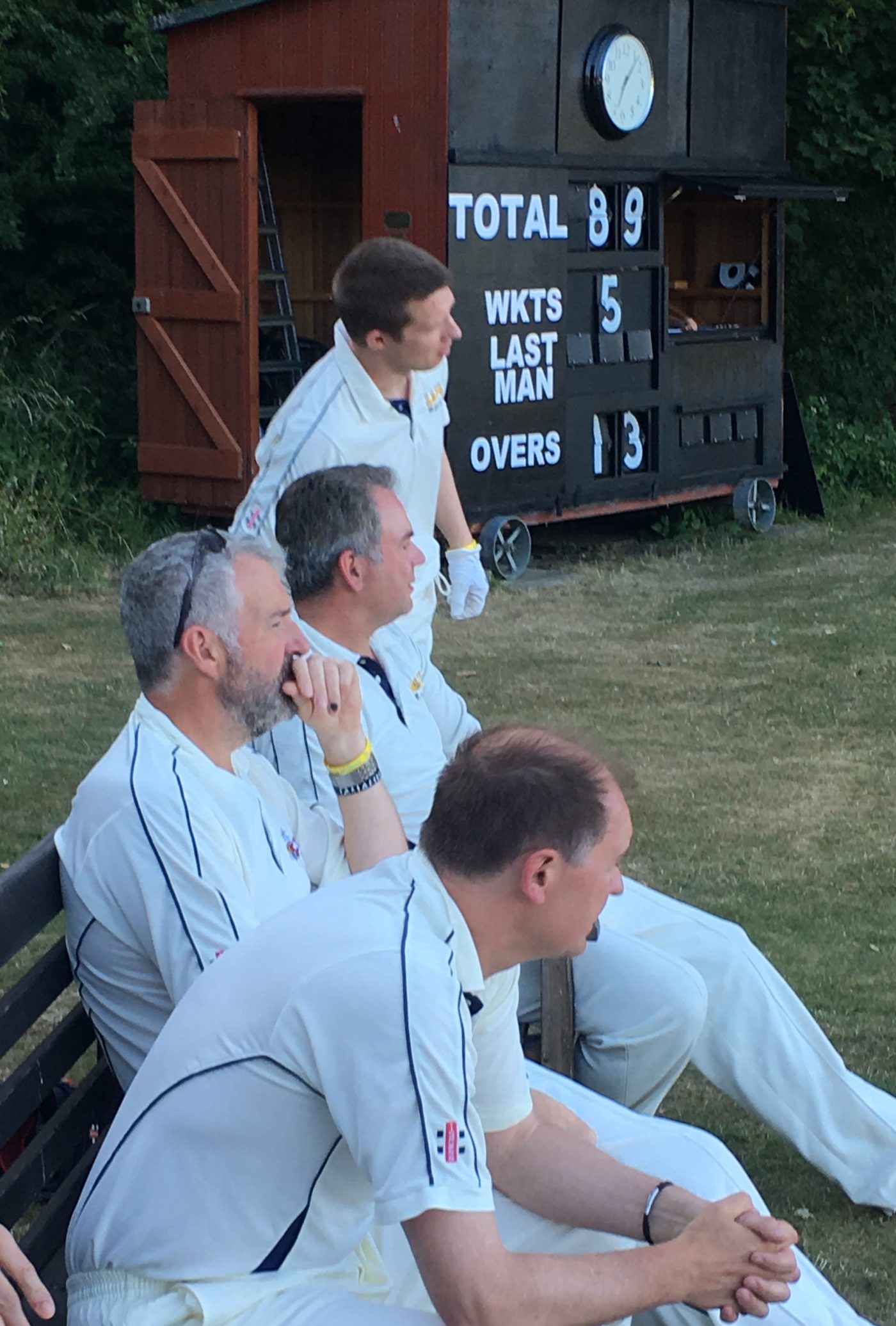
 We didn’t let the rain or our defeat by Gloucestershire Gipsies spoil the last match of our season yesterday. We were pleased that our opposition agreed to travel, despite the weather, and that eventually we were able to play a 30 overs-a-side game.
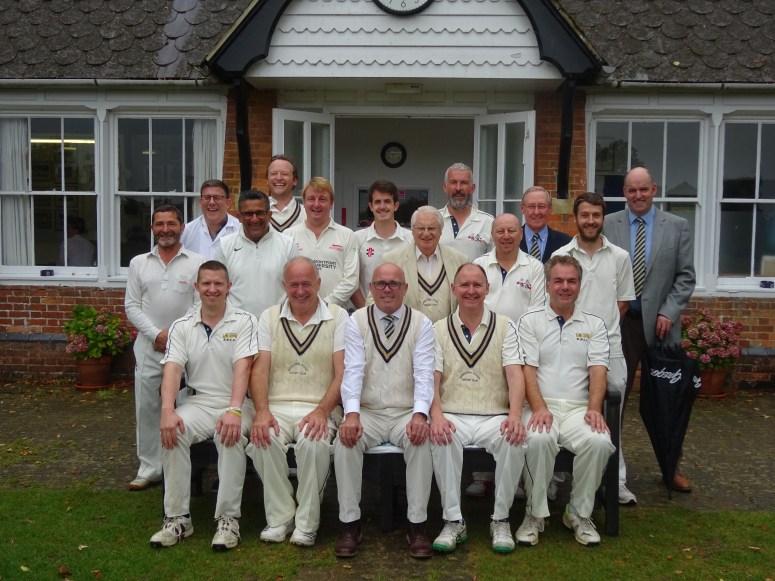
We took our annual club photo as planned, despite the rain. Rosie Cranston’s photo above also overcame the obstacle that many players had to be prised out of the pavilion where they were watching the world cup rugby. We played for as long as we could in the rain before taking an early tea and both sides joined the crowd for the barbecue, again staying outside as long as we could. We didn’t want the season to end and it hasn’t.
Our leading wicket-takers were on 28 and 25 going into this game. The leader took 2 more wickets in the maximum overs allowed in this improvised T30 but the chaser took 4 and still had five balls left to draw level. The batsman only just cleared mid-off, so the excitement of this race went to the very last ball of his spell.
When we came to bat, our last pair recorded the highest partnership of our innings. Our number 10 was the highest scorer and I, at number 11, was once again not out to survive the whole season without being out at all, although I wasn’t in very much either.
A naïve view would be that our season is now over. Some people were definitely on the pitch but did they really think it’s all over? If so, they are mistaken, as were those who ran on to the pitch in 1966. In reality, having got the actual cricket out of the way, we enter the most intense week of the cricket club’s year as we share memories, reinterpret events, determine awards and prepare for the end of season dinner next Saturday.
The deadline for our photo of the season award, for example, was midnight after the last match, there was a great deal of photography during the day and judging is now underway.
It was my turn to write the match report:
http://www.middletonstoneycc.co.uk/club-news/2019/mscc-vs-gloucestershire-gipsies-2019/
One of the privileges of club captaincy is to report on the season as a whole in the sense of determining some awards and to have some influence over others, plus the opportunity to craft a narrative about the season in a speech, or commentary on the awards, at the dinner.
This is similar to the experiences of studying and working in universities. Graduation ceremonies help to make sense of what has gone before and to encourage us to take lessons into our future lives. The Research Excellence Framework has some of the same functions. What have been your best ‘outputs’ as a cricketer? What is the ‘impact’ of your original contributions? How has the ‘environment’ helped to shape your performance?
In universities and cricket clubs alike, the challenge is to balance the celebration of outstanding achievements with the inclusion of everyone. How to do this depends on the spirit of a particular club or university. I use the term ‘paradoxbridge’, including in my tweets @paradoxbridge, because I believe there is a paradox in our understanding of universities.
We know that Oxford and Cambridge are great universities.
We know that X or Y or Z uni is not Oxford or Cambridge.
But it does not follow that X or Y or Z are not also great universities.
Similarly, we know that the Marylebone Cricket Club and the Melbourne Cricket Club are extraordinary institutions but their brilliance should not be contrasted with Middleton Stoney Cricket Club or our opposition teams. On the contrary, each kind of club can illuminate the other and it is only in seeking to understand a range of clubs that we can grasp the nature of the game of cricket. Just as vice-chancellors have opportunities and responsibilities at graduations so do club skippers at end of season events. When captains ask fellow members what should be said, the answer is invariably one which goes to the crux of the role: ‘It’s up to you, skip’.
 Up To You, Skip