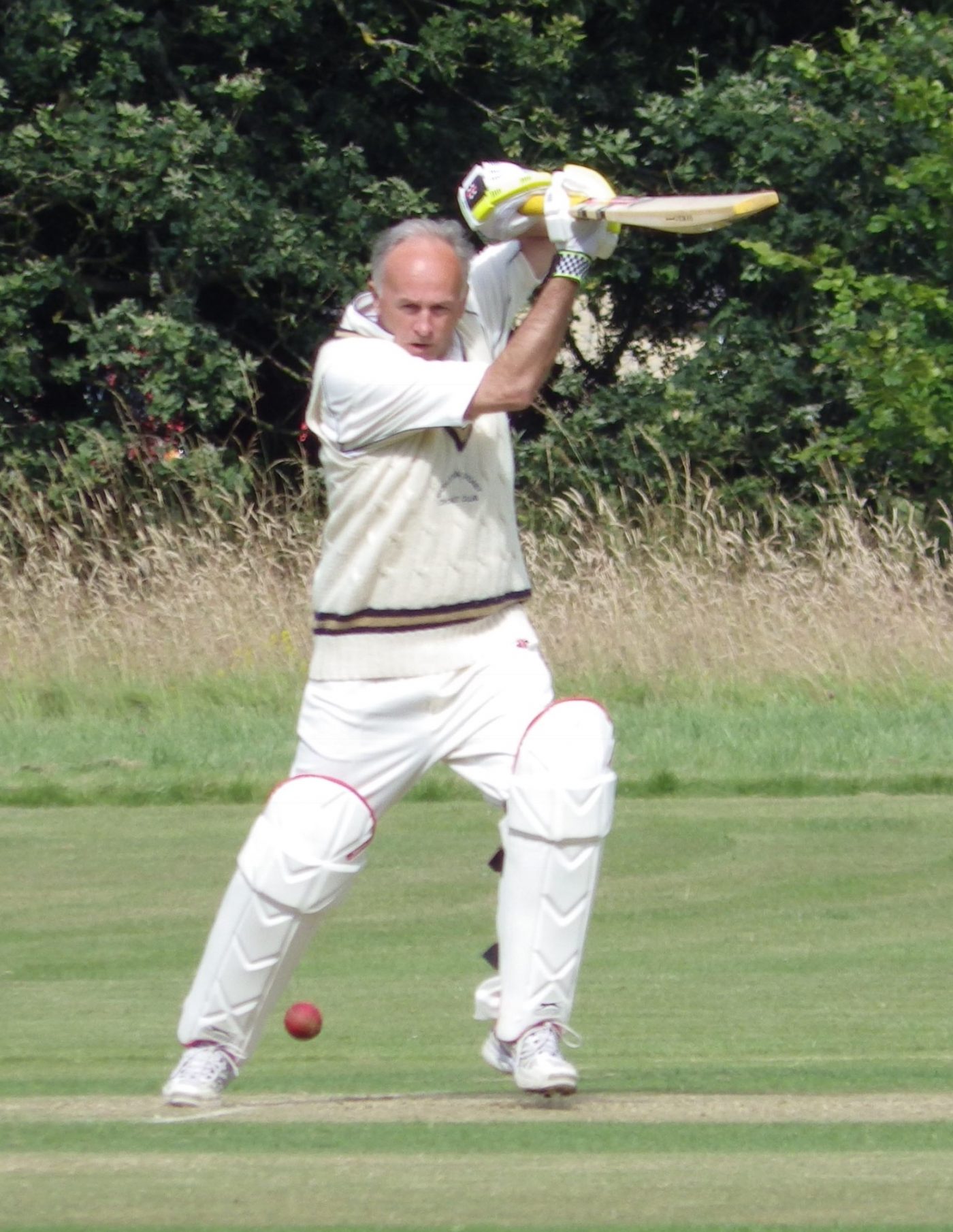
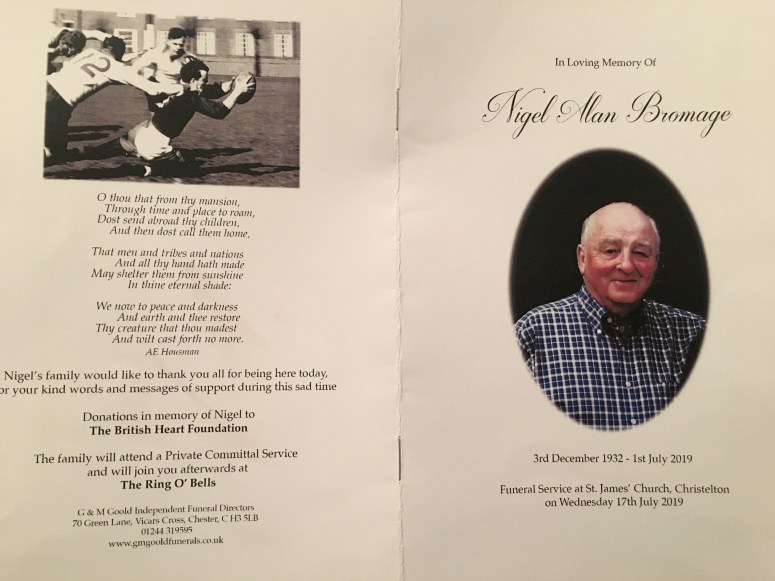
Yesterday, I went to Chester for a funeral at 1.30pm and just about got back to Middleton Stoney in time for our T20 game in the evening. Cricket featured prominently in the eulogy by Jane, one of the children of the deceased, Nigel Bromage, so I was sure he would have approved of my decision to play. Jane said that Nigel took his grandchildren to watch cricket, she told us that the last radio commentary Nigel listened to was the England v India match in the world cup and she mentioned how much he would have enjoyed the world cup final. Then the vicar, in her homily, said that everyone in the parish she had asked about Nigel said that he was a lovely man and that he loved cricket.
The order of service had a photo of Nigel playing rugby. And my memories of sporting conversations with him were almost all about rugby rather than cricket, which seems shocking now – all those missed opportunities. So why did we not talk enough about cricket? I suppose it was because we met each other in the shadow of a great cricketer for England, Bishop David Sheppard. Bishop David, Archbishop Derek Worlock, Nigel Bromage and other governors appointed me as the head of what is now Liverpool Hope University. Nigel chaired the Finance and General Purposes Committee and so was the governor in daily touch with the leadership team as we, for example, created a new campus in Everton. It was difficult enough talking about education, theology, politics or the city of Liverpool in the presence of such a figure as Bishop David. To have speculated on the state of cricket would have been even more foolhardy.
The one time when we did risk a cricketing venture was a salutary experience. In the summer of 1997, Bishop David was retiring as Bishop of Liverpool and as chair of our governors, so we decided to sponsor a game in his honour at the Aigburth ground in Liverpool. We arranged to host guests of Hope on each of the four scheduled days of the match, to reinforce our profile throughout Lancashire. Glamorgan reached 272 for 1 before the rain set in and washed out all of the second and third days. When the rain cleared on the final day, the captains had agreed a way forward. Glamorgan declared. Lancashire forfeited their first innings. Glamorgan forfeited their second. So Lancashire needed 273 to win but what happened next had not been agreed. Waqar Younis took 7 wickets, including a hat-trick, and Lancashire were bowled out for 51. This is the one time when I recall talking about cricket with Nigel. The gist of the conversation was that Bishop David supported Sussex, Nigel supported Surrey and I supported Kent.
Listening to the wonderful eulogy yesterday, I realised how much more I could have discovered about cricket if only I had engaged Nigel in more conversations about the game. I knew that he was a twin and that he had played scrum-half with his brother Michael playing fly-half in the same school team but I had not grasped that he had kept wicket to his brother who was an opening bowler, with lots of ‘caught Bromage bowled Bromage’ dismissals.
Nigel was the Bank of England’s Agent in the North-West of England, North Wales, the Isle of Man and Northern Ireland. He was always jolly. He lived to the full the ‘theology of risk-taking’ which we adopted at Hope as a counter to the risk-averse culture of so many universities. I would like to think that this is crucial to leadership in cricket captaincy, in universities and in wider life. Even in death, Nigel has taught me another lesson, that you should never be shy about sharing views on cricket just because you are in the company of better cricketers. Take your chances, so to speak. God bless Nigel and congratulations on a swashbuckling innings.
 Up To You, Skip