The temptation when rain stopped play for much of June was to write about rain and cricket. Another wet spell might yet prove irresistible. But I thought the traumas of cricket captaincy would be best simulated by this blog taking a break while our season did the same. This is what club cricket is like, periods of relative inactivity on the pitch interrupted by the weather or life leading to periods of absolute inactivity in the pavilion.
Our first Wednesday evening T20 of the season on June 12th was abandoned due to rain. So was the match on Sunday June 16th. Then the second T20 could have been lost to the weather but our assistant honorary groundsman, fixture secretary, bar team coordinator, former treasurer, regular opening bowler and part-time opening batsman (all the same person) wasn’t going to give up the chance of some wickets that easily.
As players bet against the weather or even found work getting in the way of cricket, I stood down to let others play, choosing instead to accompany a visiting professor at the Open University to watch the Wednesday evening match on June 18th. My guest Eddie Abbott-Halpin had, after all, flown from Orkney for the privilege of watching this game. He was soon swapping stories of club cricket in Birmingham with one of our social members and pointing out in the twilight that cricket could go on until 11om in the Orkneys at this time of the year or start at 3am.
We won easily on Wednesday. I did get to play this Sunday, June 23rd, having therefore missed three matches. We lost easily.
In my mind, I was going to win the toss, we were going to win the game and I was going to take my first wicket of the season. In the event, I lost the toss, we lost the game and I was part of a comedy duo who failed to go for a simple catch off the first and best of my six balls.
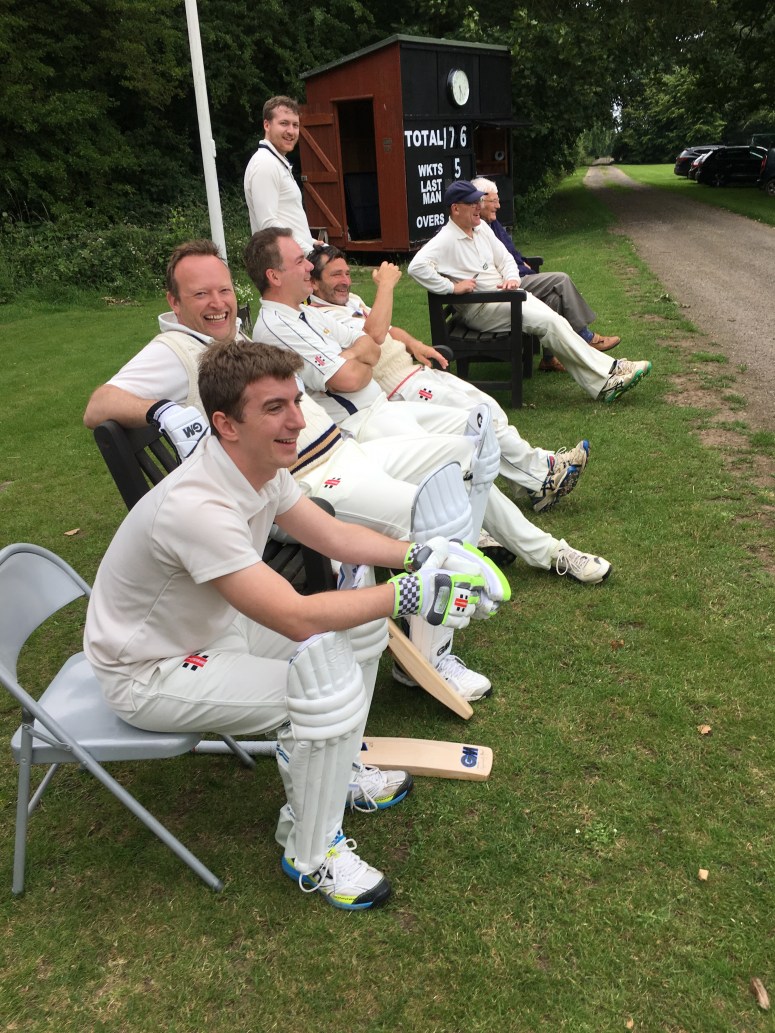
Despite getting out-played, our players were still laughing at the end of our innings and at the end of the game, principally because of the antics of our Honorary Secretary, a former captain of the club, Sathya Vadivale. The photo above shows the rest of the team responding to what, in my match report. I described as Sathya’s portrayal of Batlessman:
‘In particular, Sathya should have been run out on one occasion by twelve yards but took flight, like Superman, to make his ground. The similarity was all the more obvious because neither Superman nor Sathya were weighed down by holding a bat. Yes (wait, no), in the flurry of yes/no/wait calls that left their fielders bewildered, Sathya was not just stranded in mid-pitch but had turned into Batlessman.’
In the past, we have had one or two or three problems with bats being thrown in anger, though not by Sathya, after a player has been run out. This bat was discarded on the way to what should have been a run out, especially by a crack fielding side. Yet even they could not get the ball to the stumps while laughing. Until yesterday, we had assumed that dropping your bat to slide into first base was the preserve of baseball players.
The narrative on the boundary is always the same. If anyone does not attempt boundaries from every ball in the overs before tea, they are deemed to be playing for their average, striving to be not out when we declare. This is one of the many injustices of life in the middle and lower orders. Having not batted for a fortnight or more, players are expected to hit sixes like Chris Gayle or Carlos Brathwaite or Eoin Morgan. If they instead bat more circumspectly, they risk being barracked. If they call or run recklessly, they are teased mercilessly.
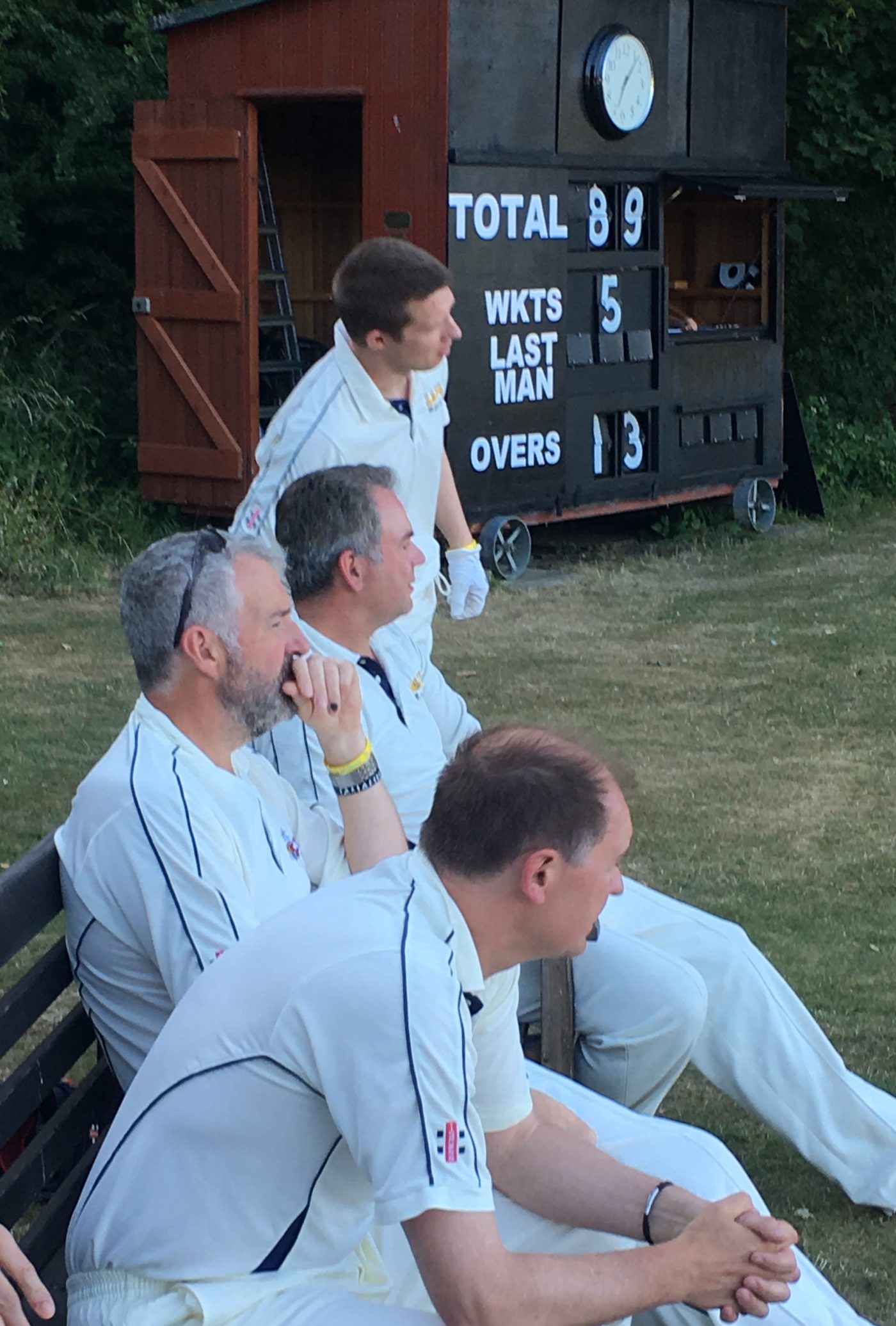
But there is another feature of this photo which echoes some of my favourite images from previous seasons. In our kind of friendly club cricket, two of the batting side will be umpiring and two will be out there in the middle, running amok. So there are only seven left between the pavilion and the boundary. If one is taking a photo, as I was, then to feature six team-mates is a full house. There was a club vice-president, the father of a player, in the photo alongside the maximum six I could photograph. They were all watching the action and they were all enjoying the show.
The opposition appreciated it so much that they made Sathya’s airborne display their champagne moment.
Even when you do not capture the action or reaction in a photo, part of the joy of captaincy is to find a way of retelling the most surprising sparkling moments of a season. If everyone is convinced something amazing is going to happen at any time, then you might think that this part of the captain’s job is done. That is indeed more than a start. In a club like ours, however, most members will not be there on a particular day, so communicating the stories to the whole club has become vital to our spirit.
You can tell much about Middleton Stoney CC and United Oxford Hospitals CC by our respective twitter accounts, @MiddStonCric and @uoh_cc, where you will see Sathya being applauded by the opposition for his and their champagne moment.
 Up To You, Skip