
 We lost on Sunday for the second time this season and for the second time in a row, this time to St Clements Strollers in a low-scoring match. It was low-scoring because we batted so badly that they only had to beat 87 to win, which they did for the loss of six wickets. So in one sense it was a closer defeat than last week’s, which was by five wickets, since this time we lost by ‘only’ four wickets, although that match went to the last possible ball. In that game, 400 runs were scored whereas this time we only saw under half that, 178 runs, in almost as long. In fact, the winners yesterday took 37 overs to score their runs.
Having been blamed match after match for losing the toss, this time I was blamed for winning it and choosing to bat first. It had been raining heavily on the two preceding days and the pitch was described by one observer as ‘a green top’.
When I say ‘choosing to bat first’, I mean choosing Middleton Stoney, not me personally, to bat first. I went in last, in my traditional place as number 11, to face my first and so far only ball of the season.
One reason for batting first was that I wanted to test the hypothesis that our regular opening bowlers could thrive just as well if given the chance to open the batting.
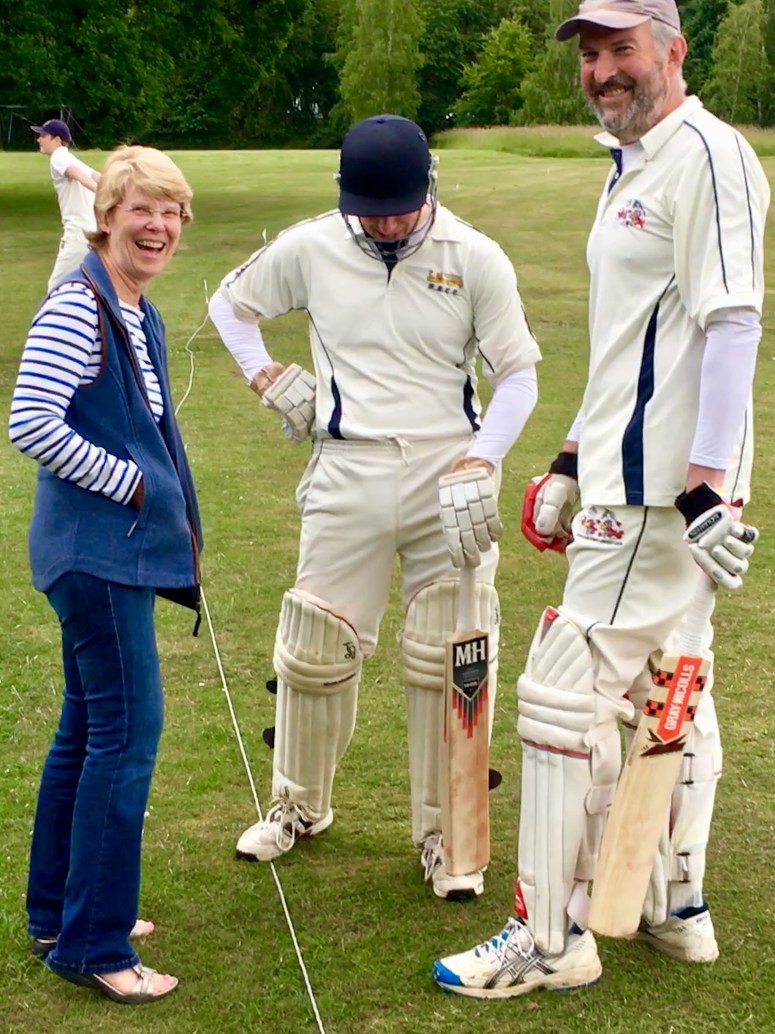
The photo evidence above seems to show that Rosie Cranston, the mother of one of the opening pair, was amused by this prospect to the point of being incredulous. Yes, in my fourth year of Middleton Stoney Cricket Club captaincy, I had succumbed to the latent pressure from our best opening bowlers to let the two of them open the batting. This was a test for these two, especially in the conditions, but it was also testing for the whole team.
We were soon 1 for 1, the 1 run coming from a wide. Tim Cranston was out, caught behind in the first over. Simon Pettit scored 2 before he was out in the third over and we were 3 for 2. As experiments in captaincy go, this was not one of my finest, although by no means my worst. Was this the first time in history that the opening bowlers have ever opened the batting together? Of course not – who can forget the First Test of the MCC tour of the West Indies in 1935 when Big Jim Smith and Ken Farnes did just that, opening the second innings and mustering 5 Test runs between them?
http://www.cricketweb.net/big-jim-smith/
http://www.espncricinfo.com/magazine/content/story/240634.html
So how was our test run progressing? No matter, I thought, that we didn’t even make the MCC’s 5, as our next three batsmen had all made centuries for the club. This, after all, had given me the confidence to take a risk on the openers. Joe Moorman batting at number 3 hit a six over long on before lobbing the ball to extra cover for 14. Mark Ford-Langstaff at 4 batted patiently for half our runs (more than half, he might observe). Jon Springer, making his debut for our club this season at 5 was responsible, with his wife, daughters and mother, for a great tea and, off his own bat, for a great run, albeit just the one.
Stevyn Jackson at 6 scored a lively 18, Richard Morris at 7 and Jack Morris at 9 made 0 between them, while Asif Kamal at 8 was also out for a duck. Stuart Batts at number 10 made our joint fourth highest score of 2 but when he was bowled, I was left ‘stranded’ on 0 not out. So we had managed a school game total (or MCC v West Indies, 1935, total) of 87, thanks to Mark’s 44, and were all out inside two hours.
After the regulation 10 minute interval, St Clements Strollers had twenty-five minutes to bat before tea. I asked Asif Kamal and Jack Morris to open the bowling, which they did well for 4 and 3 overs respectively before I gave each of our regular opening bowlers, the ones who had opened the batting, the chance to take a wicket before tea.
They bowled so well that I kept them on and on after tea, and even brought them back. Joe Moorman had a short and lively spell but Stuart and I didn’t get to bowl as we prefer a safety margin of 200 runs.
Good ground fielding, even (if I say so myself) by me, and a sensational catch by our wicket-keeper, Richard Morris, supported our bowlers.
http://www.middletonstoneycc.co.uk/club-news/2019/mscc-vs-st-clement-strollers-2019/
Strollers were 15 for 3 but their number 5 saw them through, even though we dismissed a further three of his partners. He finished with the flourish of a 6 which brought up his 50 as they reached 89 for 6.
The scorebook shows that I persisted in bowling our opening batsmen for 23.2 overs out of our 37.2 overs, or (since what comes after what appears to be a decimal point actually means 2 out of 6 balls) 140 out of 234 balls or almost 60%. The figures are slightly different if wides (their third highest score at 7) are considered but that will do to give a sense of the proportions.
This is one of the unusual points about this experiment. First, despite our ethos being to give everyone a fair chance of a game, the trouble with my particular experiment of letting the normal opening bowlers open the batting is that the worse they fared in their unaccustomed role, the more likely it was that we would need them also to bowl for even longer than usual. In the spirit of the times, in which politicians give their schemes names such as the Malthouse Compromise, we could dub this The Opening Cranston-Pettit Paradox.
Second, if the rest of the team were the kind of people to whinge, you would expect others to have had an even worse day of cricket than comes with the experience of losing itself, which is bad enough, yet we were sharp in the field and our spirits were high. This is The Continuing Cranston-Pettit Paradox. It is the wonderful club spirit which meant that the rest of the team, despite paying £10 each for the privilege of not doing very much while watching their captain experiment their way to a defeat, managed to give the impression of enjoying the day.
This is partly because the experiment entitled them to have a go at the captain for evermore, partly because they can tease the two stars similarly, partly because it brings alive the possibility that they might have their own dream opportunity one day but mostly, deep down (and don’t tell the two players in question, #justsaying) because everyone could see that they deserved their chance.
Moreover, although many deny reading this blog &/or claim that it is an awful idea, a violation of a home team’s version of ‘what goes on tour stays on tour’, or deny reading it and still condemn it, and insist that they would resist following any cricketing sense it might disseminate, even if, counter-factually, I knew what I was talking about, the most touching aspect of this allegedly failed experiment is that it prompted the rest of the team to implement the point in my previous post, #9, the one about Carnegie student rugby league players making up for someone else’s mistake. Everyone seemed to concentrate on every ball in the field. We ran them close.
Finally, though, The Never-Ending Cranston-Pettit Paradox is well put by one of the duo in his commendably prompt match report. As Tim Cranston observes, ‘had the experiment failed? Well it may seem so, but in the interest of scientific endeavour experiments should be repeated in order to confirm the results – Up to you Skip! (though if the real reason was to prevent bowlers from moaning about not getting to bat, I fear this may also have failed!)’
There is nothing that can happen, it seems, no defeat, no abject low scores, no long spells, that will stop opening bowlers from thinking that they should also open the batting.
 Up To You, Skip