
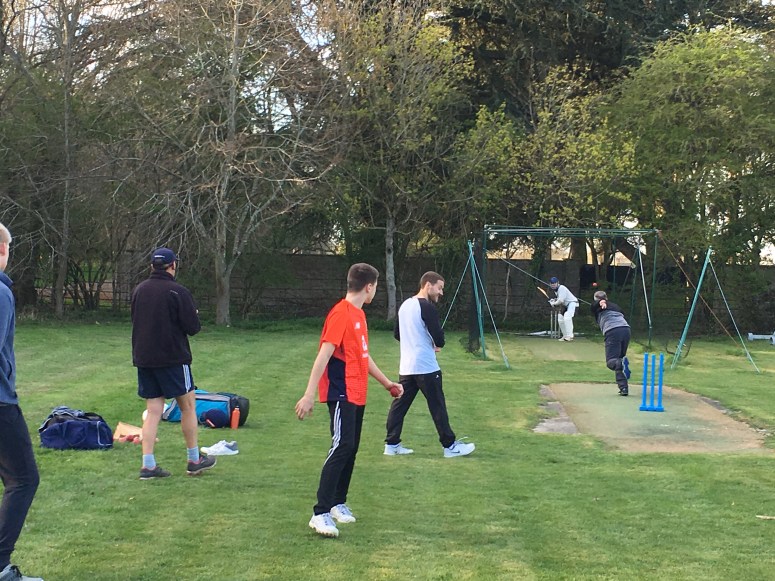
Nets, or in our case, a single net, is the cricketing term for practising or for standing around laughing about last week’s game. Practice pitches are set up, usually beyond the boundary, and are surrounded by netting which means that the balls are easily retrieved. Well, they would be if the balls didn’t so frequently find their way through or over the netting, either having beaten the batsman and found a hole in the netting or having been hit by the batsman into the far distance.
Cricketers tend to talk of ‘nets’ in the plural even when there is only one net although batsmen sometimes talk of ‘having a net’. The implication is that batting is what counts and that bowling in the nets is hard work so the gentleman/batsman works on his game with others serving him up balls which he can hit. On the other hand, bowlers have the advantage of being able to practise in nets on their own, for instance putting down a handkerchief on the spot where they are trying to pitch the ball and bowling ball after ball without the distraction of being smashed out of the net.
Some clubs give batsmen notional targets of, say, 15 to win off the last six balls which brings each turn in the net to a lively close. It is usually up to the skipper or senior pro present to adjudicate on how many runs would have come from each shot or whether to call a wide. This illusion of authority is one of the most enjoyable aspects of being the captain.
MIddleton Stoney CC has a pre-season indoor net at a Test ground (Lord’s or Edgbaston) and then outdoor nets at our ground every Wednesday evening of the season.
It would be easy to suggest that nets don’t work, at least if the point is to improve performance or to play to the best of one’s abilities, but our leading run-scorer last season has long been an assiduous user of nets and he thinks our net pitch is excellent.
In any event, the value of nets is broader than that in terms of team spirit, especially through the banter between the bowlers as they cluster ready to take their turn, commenting on the batsman’s shots, how he would have been out if they had been granted their ideal field-placings and ideal fielders, how others are bowling, how the last match went, and so on.
Even as far as improving performance is concerned, nets can work. First, although people can get worse, as Brearley and others have noted, through repeating poor technique, they can also get better. Second, several of our batsmen have turned themselves into all-rounders through bowling so much and so well in the nets. Third, occasionally a bowler strikes the ball so well with the bat that he rises up the lower order.
Conversely, batsmen sometimes hit the skipper so far out of the nets, or play such outrageous switch/ramp shots that they might find themselves tumbling down the order, if the captain is the sort to hold grudges. Just saying.
My school cricket 1st XI benefited from daily fielding practice (of which more in a later post) and playing out in the middle whereas I don’t recall nets making a difference. During the winter, however, I went to weekly indoor nets run by Kent CCC in a dedicated facility, where one of the county’s opening bowlers, John Dye, coached me. He was a left-arm fast-medium bowler whereas I was a right-arm spin bowler, which my current team-mates might think explains a great deal. He was also a confirmed tail-ender batsman. More importantly, he was an excellent coach. When I went to university, the captain Vic Marks led the weekly winter nets which were open to all-comers. Both these enterprises were open to all and serious.
In the context of a blog about the lessons of cricket captaincy for wider life, the simple points I would like to make are that nets matter for the spirit of a club (as do training, practising, rehearsals and development in different kinds of enterprise) and that the skipper can learn much about the temperament and latent talents of fellow club members from the nets (or from similar opportunities in other walks of life). The conversations can be predictable: ‘Would you like to pad up next?’ ‘Up to you, skip’. But the quality of batting and bowling can be surprising. In too many organisations, such as universities, too many leaders only get to see too few established stars in action and then only when they are performing. There is a great value in finding the equivalent of nets, a weekly opportunity for the least confident to practise with and against the most acclaimed.
 Up To You, Skip