In cricket, captains make changes. In wider life, when I have been brought in to lead some endeavour, the phrase ‘managing change’ rather underplays the task. The leadership of change in universities or charities or the arts is better described, in my opinion, by a different term from sport: trying to be a ‘game-changer’.
Changing the batting order to accommodate the late arrival of team-mates, or their lack of confidence once they have seen the opposition warming up, or their superstitions when neither wants to face the first ball, is probably not an everyday occurrence for the Mike Brearleys of Test cricket captaincy but it happens at grassroots level. Changing the batting order further into the innings in a T20 makes sense to the Eoin Morgans of limited over captaincy but can seriously upset a club cricket team’s number 7 who has been waiting all evening for their chance only for number 8 to leapfrog them on the usually deluded instinct of the captain, lobbied by the number 8, that the latter is more likely to hit a 6. This is one of many occasions when ‘Up to you, skip’ is the disappointed player’s choked reaction.
Changing the bowling is more obviously central to captaincy at all levels of cricket. It does not seem quite so obvious, however, to the bowlers themselves, most of whom are convinced that they would make the breakthrough if only given another over, or two. ‘Up to you, skip’, some say, with injured pride. All bar one of our club’s bowlers, so far as I am aware, like to know when the captain is thinking of taking them off, so that they can put all their energy and craft into their last over of a spell.
What this means, sadly, is that almost all faster bowlers in village cricket have a slower ball up their sleeve (or, rather, not concealed by their short-sleeve club shirt or manner of delivery), which they wish to deploy on their penultimate ball, followed by their fastest possible delivery to round off their spell. For some reason, this irritates me far more than the opposite tactic of slower bowlers putting in the occasional quicker ball (as I have been known to try to do myself).
Another reason for wanting to know the captain’s thinking is the naïve belief that the bowler might prolong a spell by taking a wicket and then pleading, ‘One more, skip?’. For the early years of my cricket captaincy, I applied an absolute rule of rejecting such requests, not least in fairness to the next hopeful. One of the signs that it is time to hand over the captaincy is a weakening of my resolve. Two years ago, I took off a star bowler immediately after his hat-trick, all clean bowled, to give others a chance. To his credit, he didn’t seem to mind. Now that we have an honours board for those who take five wickets in a match, however, I might occasionally yield when a bowler implores me to give them just one more over to achieve immortality.
I went soft in similar fashion in my academic life but cured the problem by taking a twenty year break from writing about judges when I found that I was getting too close to them, or coming to feel sorry for them. I was losing my touch. Admittedly, the judges in question were terrorist targets in Northern Ireland during the Troubles, so my sympathy for them was more explicable than any indulgence of bowlers who cannot seem to hit the target. Still, after my prolonged spell in academic leadership, I have bounced back into research in the law and would like to think that I am back on form when it comes to having a go at judges.
Changing field-placings has already been touched upon in this blog and will doubtless feature again in later posts but the most important issues for a village cricket club captain are when unforeseen circumstances dictate a last minute change in the six bigger challenges: the team list, the tea rota, the umpiring rota, the scorer, the post-match-barbecuer and the match reporter. These are inter-linked in ways which England captains from Wally Hammond to Mike Brearley and Joe Root have rarely discussed.
I had the easier duty of inviting our 12th Man to play. But this altered the whole dynamic of the team, not merely because the 12th Man is an opening bowler for his school sides but more importantly because we don’t submit our 13 year-olds to the pressures of umpiring or scoring or barbecuing. Thankfully, our club scorer was there all day yesterday but sometimes players have to score and not all are able to juggle the skills of following the game, writing neatly, using coloured pens, and keeping the scorebox up to date.
(Don’t get me started on the batting side’s players’ attitudes to keeping the scorebox up to date, which is a matter for later blogging. Indeed, that issue, rather like the score on the box, needs constant posting.)
Not surprisingly, both those player-scorers are also excellent umpires but we haven’t yet worked out a way for them to score and umpire simultaneously. If someone batting at 9 is not going to umpire, and you are already excusing number 10 because he has only just started playing the game, the pressure is on the rest of the team to take their turns. It only needs one or two other players to be preoccupied (understandably) with their young families on the boundary, and there are few umpires to rotate at our level of cricket where an independent umpire is a rarity. Two of the team will be batting. For much of the game, someone will be recovering their equilibrium after being given out. Two more will be padded up. So the choices are limited.
Not everything changes. One constant is that however good a cricketer our 12th Man is, and however old, he will never find the ball which has been despatched over his head and beyond the boundary into the slightly longer grass, but his mother or father will race around the ground to find it immediately. Thank you, Rob.
Changing the ethos of a club or a university or any other community or society is not easy. It is certainly not achieved by a captain on their own. There are mixed views on whether it helps for the club to set out what it thinks its ethos is. With or without an overarching statement, my sense is that the most significant changes a captain or other ‘game-changers’ can make are tiny, often imperceptible, adjustments to the field, the batting order, the bowling attack, the tea rota, the umpiring rota, selection, match reporting and the rest.
For instance, I stopped the club tradition of fining players for mistakes, which used to dominate the post-match gathering, replacing it with a champagne moment, awarded (and paid for) by the home team captain. The knock-on consequences of any such small change can be huge. For instance, the considerable fines during the course of the season used to fund the first two hundred pounds-worth of drinking at the annual dinner. That gap is made up now by the generosity of the club’s president and/or the club vice-captain and/or the fixture secretary.
One of the joys of the champagne moment is that anyone can merit it right the way through the match. Yesterday, it went to someone who had never played cricket until he came to our club, through a colleague at work, last year. I have mentioned him already in these posts, partly because his surname, Batts, just cried out for a chance to play this great game and it fell to us, at Middleton Stoney Cricket Club, to provide the opportunity.
Last year, Stuart had the most economical (runs per overs) bowling figures in the whole club, partly through his own assiduous attendance at weekly nets, partly through coaching and encouragement from fellow members, and partly through what I like to regard as my own careful bowling changes.
Yesterday, he went one, or rather two, better. He took his first ever wicket, and then another wicket. For the second, he was helped by one of our fielders taking his second brilliant catch of the afternoon. The champagne moment went to the first wicket, mostly because it was the first in Stuart’s life and partly because it was clean bowled. Who wouldn’t want to be in a club that can change around the cricketing life of a novice called Stuart Batts? The joy of the whole team outweighed our disappointment at the drawn game. All our players rushed to congratulate the wicket-taker. That fizzing delivery enabled everyone to say, of Stuart Batts, ‘Stuart bowls!’.
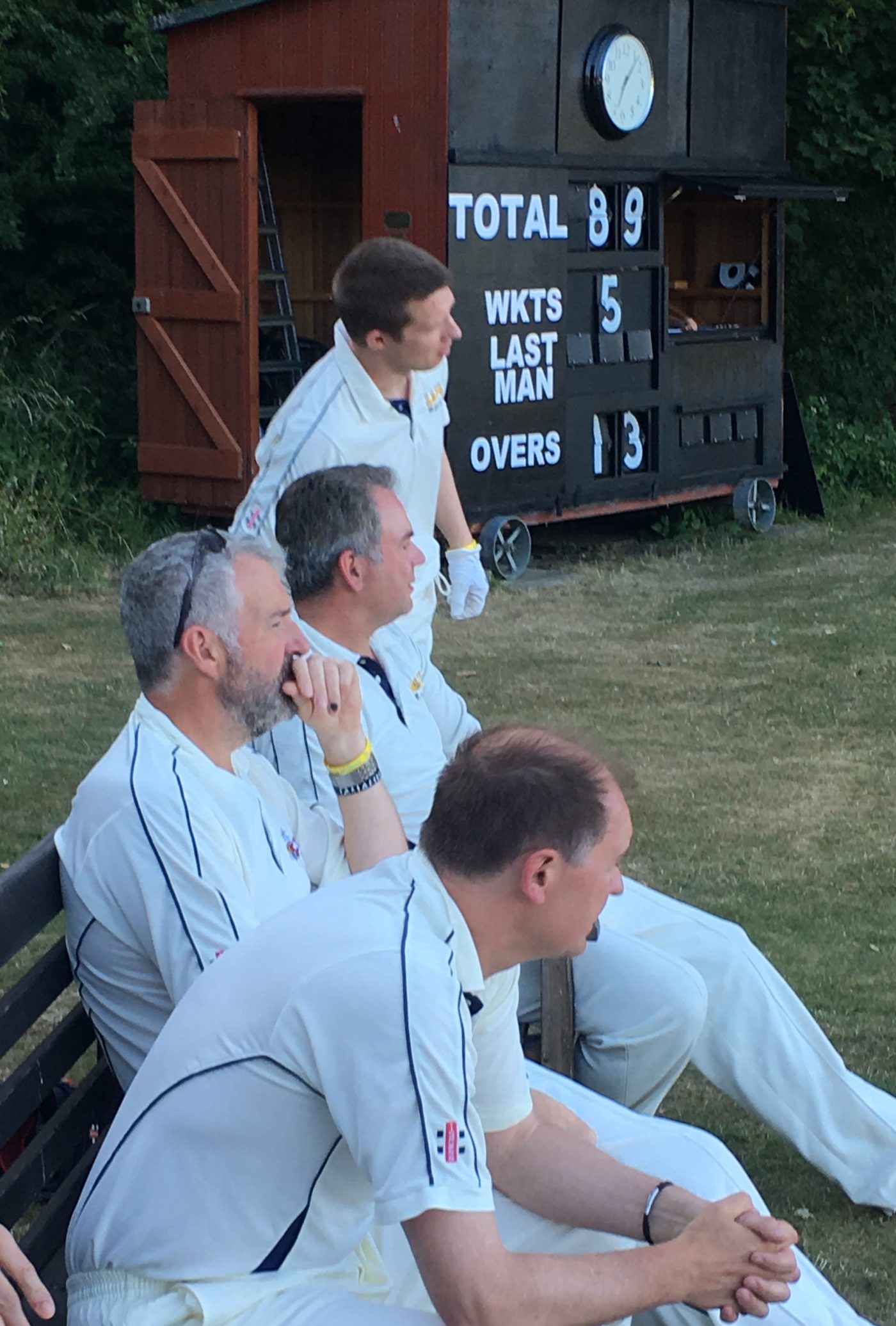
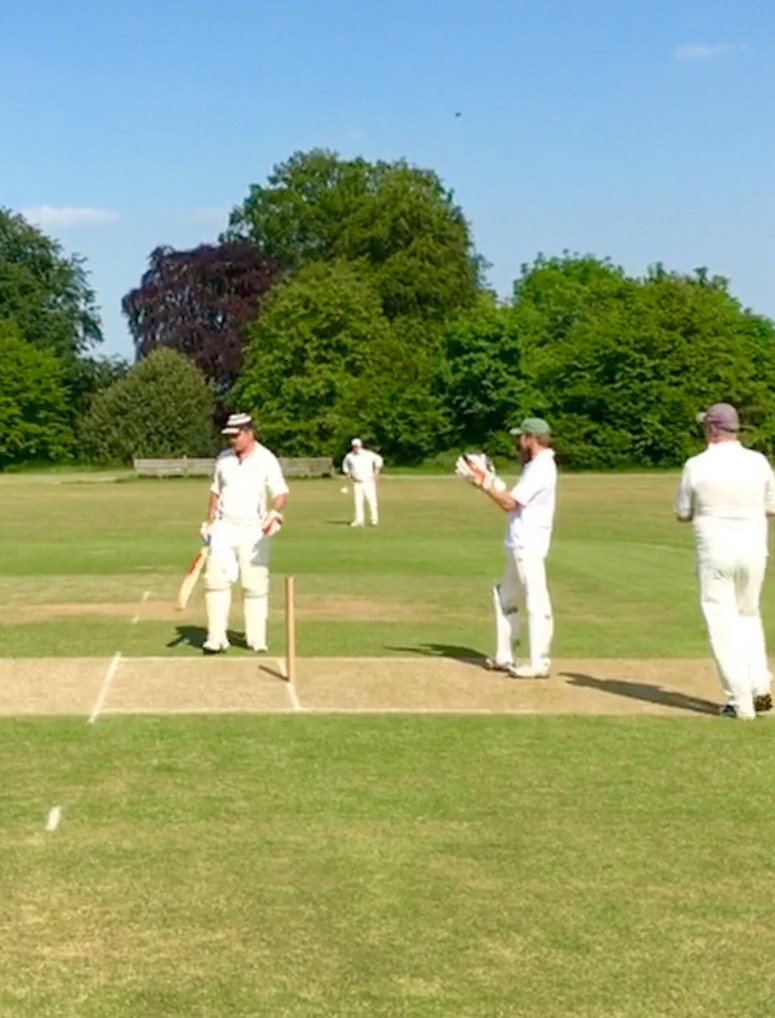
PS Photo explanation: this year’s match report by Mark Ford-Langstaff modestly glosses over his own innings yesterday
http://www.middletonstoneycc.co.uk/club-news/2019/mscc-vs-rainmen-2019/
so I have added at the top of this post a photo of last year’s game when the Rainmen were applauding his century.
 Up To You, Skip