
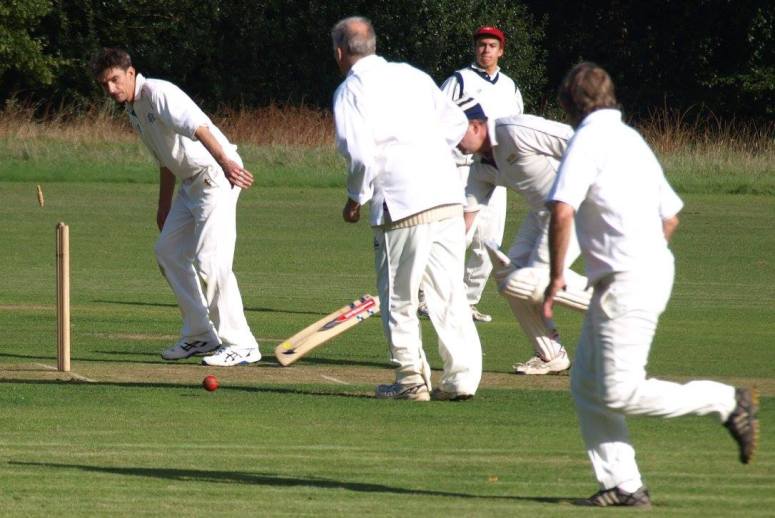
Mike Brearley was recalled to the England captaincy, he recalls various incidents in his books on cricket and he has faced the issue on the field of whether or not to recall a batsman when allegedly given out in error. There is a lot of recalling involved in cricket captaincy and in other forms of leadership. MPs can now be recalled in a different sense, called back to account by 10% of their electorate if, for example, they have served a prison term, under the Recall of MPs Act 2015.
Strictly speaking, it is the umpire who has given a batsman out who can recall the batsman and rescind his decision, and what the captain is doing is a precursor to that in withdrawing his side’s appeal. These two aspects are wrongly conflated in our club or village cricket when we talk of recalling a batsman or, less formally, of calling the batsman back. This happened in our first ever game against The Bushmen on Sunday:
http://www.middletonstoneycc.co.uk/club-news/2019/mscc-vs-the-bushmen-2019/
Their captain was given out LBW by one of his own players, umpiring rather than preparing to bat as he had dislocated his finger in the field. This didn’t stop him raising his umpiring finger to send their skipper on his way, the fourth victim of a bowler who was now well on his way to a place on our honours board. Until, that is, the opposition skipper was told by our reliable and shrewd judge of a square-leg fielder and by the square-leg umpire, one of our best ever players, who had come along to watch and who has the rare distinction at our level of cricket of having taken an umpiring course, that they thought he had hit the ball before it hit his pad.
If the opposition skipper maintains he hit the ball, and so do our fielders and ‘our’ square leg umpire, I tend to ask the umpire at the bowler’s end if he would reconsider and let the batsman play on, which the umpire generously agreed to do, apologising for his mistake. Our bowler, however, was not impressed with my call or with the recall.
After the game, I went back to my copies of Brearley’s books, to the Laws of Cricket and to the BBC, since we were playing The Bushmen, whose origins are in Bush House, formerly the home of the BBC World Service. The BBC website warns that it is not updating this question and answer archive page on the meaning of the word ‘recall’:
http://www.bbc.co.uk/worldservice/learningenglish/grammar/learnit/learnitv204.shtml.
The Laws of Cricket tell us
‘31.8 Withdrawal of an appeal
The captain of the fielding side may withdraw an appeal only after obtaining the consent of the umpire within whose jurisdiction the appeal falls. If such consent is given, the umpire concerned shall, if applicable, revoke the decision and recall the batsman.
The withdrawal of an appeal must be before the instant when the ball comes into play for the next delivery or, if the innings has been completed, the instant when the umpires leave the field.’
Mike Brearley tells us, to my surprise, that he did not always recall (or technically ask the umpire for consent to withdraw an appeal) even when the opposition captain appeared to be demanding from the balcony that Brearley should do so. His example was a dispute over a run out of an Essex batsman by the Middlesex wicket-keeper. This is my excuse for the photo above, which is of the very last moment of our last innings in the 2016 season, when one of our stars, the match reporter for Sunday’s game, was given run out by me (I was also playing and was captain but at this stage I was umpiring and still, I am delighted to report, concentrating sufficiently to make the right call, brilliantly captured by a photographer, also playing, our club vice-captain). Fortunately, everyone agreed with that particular decision and we have evidence to show it was right but when there is such a fine line between in and out, with no possibility of an action replay or a ‘snickometer’ reading, Brearley reminds us that people can make mistakes. Coming back to any incident like the one in our game on Sunday, anyone might have misheard, umpires, bowlers, batsmen and fielders, including captains.
This is one of the reasons why Brearley is much more tolerant of flashes of dissent. He also likes the competitive instinct underlying some of the aggression in the modern game. According to Brearley, ‘the British have become less inhibited in the last generation, … more volatile’ which means, in the professional game, that ‘captains are under more pressure. They have to make decisions quickly, in response to rapidly changing situations. They have to deal with players, including themselves, who are at a generally higher pitch of excitement, anxiety, elation or dejection. It is not surprising if traditional courtesies are eroded in such an atmosphere, or if the captain’s own temper is liable to become flustered.’
Well, not in Middleton Stoney, I trust. Brearley’s chapter (‘Kicking over the traces’ in The Art of Captaincy) has some opposing views, where he says that ‘it is a sign of maturity to own the desire to do well individually and collectively, but of childishness to let it run away with one’, although that could be a little unfair on children, and ‘I would support the now unfashionable view that one of cricket’s lessons for life is to teach its players to take the rough with the smooth …’
Talking of which, how did The Bushmen’s captain fare after his recall? He was recently President of Cricket at the University of York so his return to the crease gave one of his team-mates from those student days, now one of our opening bowlers, the opportunity to clean bowl him in a second spell. He took that opportunity. This time, there was no recall.
But when the captain does ask the umpire if the appeal might be withdrawn, the spirit of cricket is that everyone, including the umpire and the bowler, who have the most to lose, accept that call, even while disagreeing with it. In which case, the last words would be the bowler’s, ‘Up to you, skip’.
 Up To You, Skip