
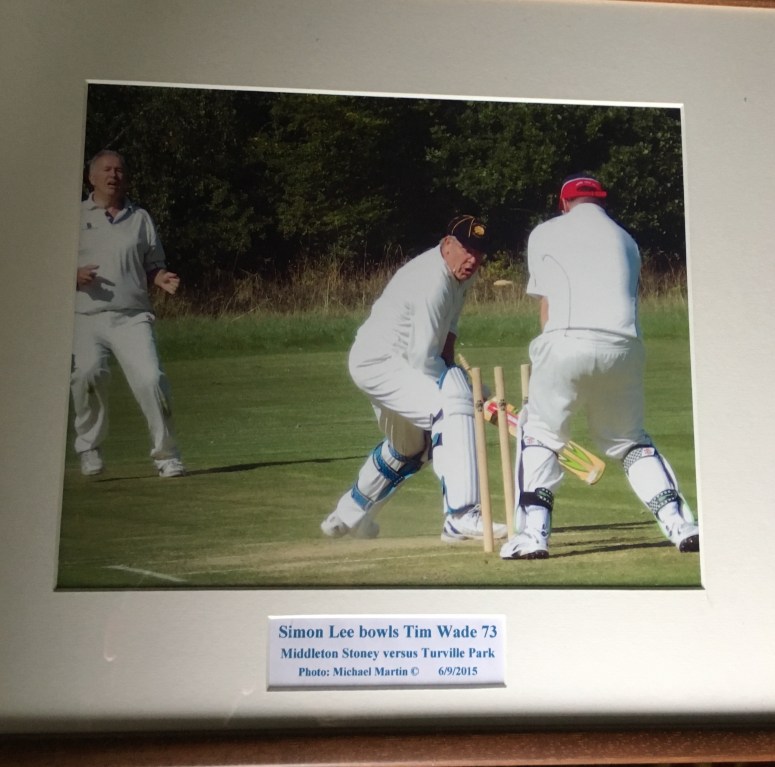
Up to you, skip #3: The beauty of cricket
According to Wally Hammond, a former captain of England writing before I was born (Cricketers’ School, 1952), the real beauty of cricket is that ‘one can start learning the game as soon as one can walk, and go on learning for the rest of one’s life’.
Hammond’s rallying cry is that, ‘Every player in every side, however small or important, must realize that some responsibility rests on him personally to improve his play, to help others to do so, to learn steadily and to apply his knowledge.’ He says that zeal is needed and that revival should start with the ‘little clubs that are the backbone of the English summer game’. He wants to see these ‘teams turn out on the tick of time appointed, look smart and eager, and play with every atom of spirit they possess till the last ball is bowled.’
I think that was pretty much the story of Sunday’s game between Middleton Stoney CC and Harry Baldwin’s Occasionals. Mind you, like so many sides visiting us in deepest Oxfordshire, Baldwin’s were not all completely ‘on the tick of time’. Captains of wandering sides might as well come with a badge saying, ‘Some of our players are stuck on the M40’. My tip is to leave earlier. Just saying. That’s easy for me to point out, they might retort, since I live at our ground.
Our debutant, Alex Ooms, looked ‘smart and eager’, having shaved his head since his appearance at our indoor net at Edgbaston. Alex took a superb wicket in his first over and two more in the match. We have been looking for a left-arm over the wicket opening bowler since a previous net star failed to play a single game for us. I mention ‘over the wicket’ because the opposition’s opening bowler was the even rarer specimen of a left-arm round the wicket fast bowler. He bowled from as wide of the crease as was possible and appealed every time the ball hit the pads. Frustrated by the umpire (myself) being unmoved, he eventually decided to switch to bowl over to one of our opening batsman and round to the other. Given the single sight-screen behind him, this extended his overs considerably as the screen was moved from side to side.
His earlier reverse sweep for four off my bowling, batting at number 9 but on his way to his first 50 for their club, had absolutely nothing to do with my reluctance to give him the LBWs he demanded. Nor, more generally, was I irked by what happened in the rest of my solitary over, such as the huge six over mid-wicket by his partner, their number 11. Indeed, I blame myself for being too economical in that if I had given away more than that miserly 15, our batsmen would have had a bigger total to chase. Instead of Mark Ford-Langstaff having to hit two sixes to win the match and reach his century, at which point he hit one colossal six but was then out for 95, he could have coasted to another place on our honours boards. As it was, we reached 164 for 4 with time to spare, after bowling out for 163 on the stroke of 4 o’clock, which was the appointed time for tea. There had been a danger, until I came on, that we would have bowled them out too soon and had to bat for a few overs before tea. This is just one of the ways in which, at our sub-Hammond and sub-Brearley level, cricket captains can make a difference.
As for what Hammond meant by ‘playing with every atom of spirit they possess till the last ball is bowled’, Harry Baldwin’s Occasionals demonstrated this by catching out a batsman in top form on 95, when they needed to take seven wickets for five runs. This is what makes for a beautiful game.
On Hammond’s point about helping others to play well, our fielding is getting even better. Great catches by our wicket-keeper, Tim Riley, and first slip, Nick Moorman, made all the difference, as did the ground fielding of club vice-captain, Tim House, in the covers. Above all, team spirit on both sides made for an enjoyable atmosphere as Baldwin’s players cheered the batting of a couple of less confident batsmen in their middle order, as well as their impressive tail-enders, and all the other Middleton Stoney players encouraged our relative newcomer to the game as he bowled well. His name is Stuart Batts, a surname which is a gift to our match reporters (of whom, more anon in later posts in this blog). Stuart and Abi rounded off the day by taking charge of our new barbecue, an aspect of this beautiful game which escaped Hammond’s notice.
Wally Hammond’s books on cricket are insightful and he is right that one of the attractions of cricket is how you can keep on learning about the game even when physically you are past your most athletic days (or years or decades). What is salutary, however, is that while Hammond was one of the best batsmen and fielders of all time, and a good bowler, he was not so highly regarded as a captain or as a team-mate. We all know that reading compelling books on cricket does not make you a great cricketer. Otherwise, I would be a good player. Similarly, there is considerable evidence that studying the human condition through playing cricket does not necessarily make us nicer characters.
Nevertheless, I bought this book by Hammond at Hay-on-Wye recently because of a story Mike Brearley tells against himself in his book, On Form, and which we considered in our close season book club evening. On the MCC’s 1964-5 tour of South Africa, Brearley was not selected for the first Test in Durban but was having a net during the match. As he came out, a man who had been watching him practise,
‘asked quietly if he might make a comment on my batting. Yes, of course, I said. He suggested that I was holding the bat too tightly, as if my life depended on it. He said I needed to relax my arms and both hands, especially the top hand. I listened politely. And walked away.
‘At some point I was told that this sallow man who seemed old to me (he was only sixty-four and died of cancer a few weeks later) was none other than Wally Hammond, one of England’s most successful batsmen, and one of the greatest stylists of all time. Despite knowing this, I did not properly take on board what he had said … I thought I knew better.
‘It took me a decade to realise the truth of what Hammond had told me …
‘I was arrogant not to take any tip from Hammond seriously.’
Cricket is a humbling sport. We are unbeaten all season so far, if three games count as ‘far’, but who knows what might happen next week against new opposition, The Bushmen? It all looked quite easy bowling to Baldwin’s until I came on to be hit all over the ground. We have batsmen galore in form but any one of them could be out first ball. Even our most talented fielders have been known to drop a catch. But the beauty of the game is, in my opinion, the endless opportunities it provides for learning afresh about each other and ourselves, even if we find it difficult to take those chances. And even if a team loses, as Baldwin’s did on Sunday, it can still be a triumph of a different sort if a team plays ‘with every atom of spirit they possess till the last ball is bowled.’
 Up To You, Skip